To break up a dog fight, start with methods that keep your hands away from the dogs' mouths: a loud noise, a splash of water, or a barrier like a board, a trash can lid or a jacket pushed between them. If that fails and there are two people, each person can grab their own dog by the back legs and walk it backward, the "wheelbarrow" method. Never grab a fighting dog by the collar or put your hands near its head.
In this guide
- Is it play or a real fight?
- Why shouldn't I grab my dog's collar?
- What should I try first?
- How does the wheelbarrow method work?
- What if I'm alone?
- What should I do after the fight?
- What should I carry in case of a fight?
- Can my dog go back to the park after a fight?
- How can I prevent dog fights at the park?
- Frequently asked questions
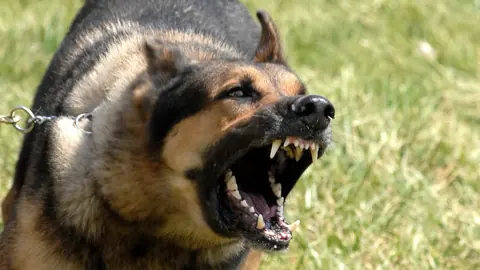
Most dog park scuffles are loud and short and end on their own in a few seconds. A real fight is different: the dogs lock on, don't respond to their names and don't stop. These steps are for that case.
Is it play or a real fight?
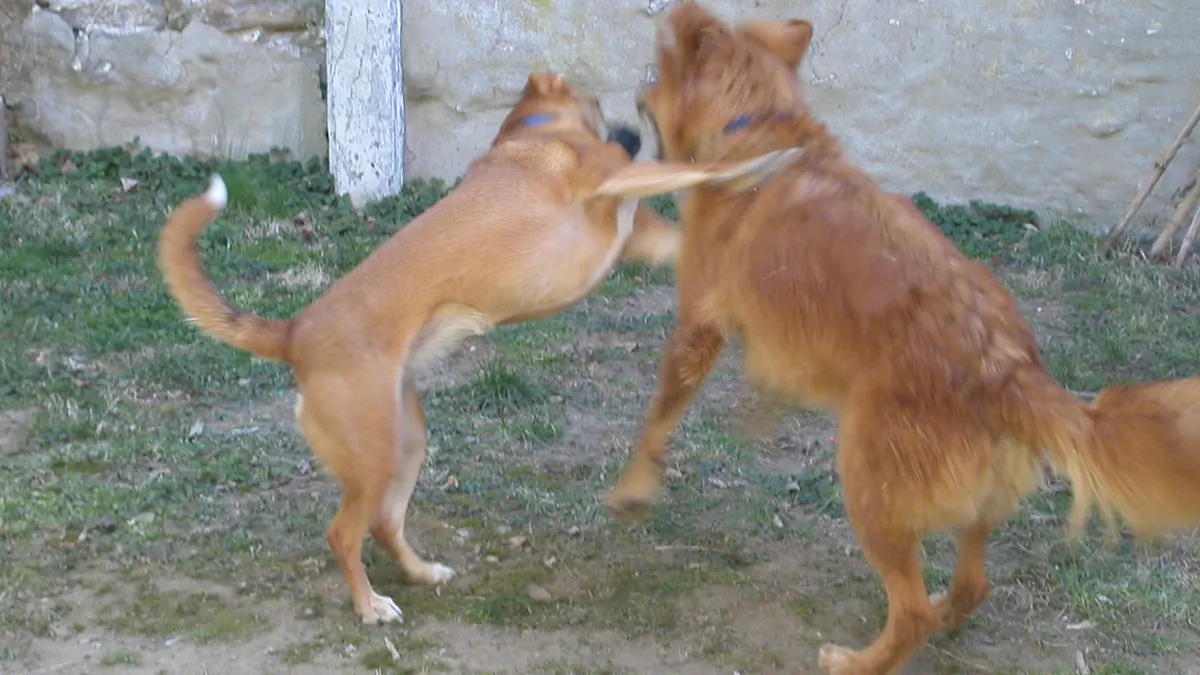
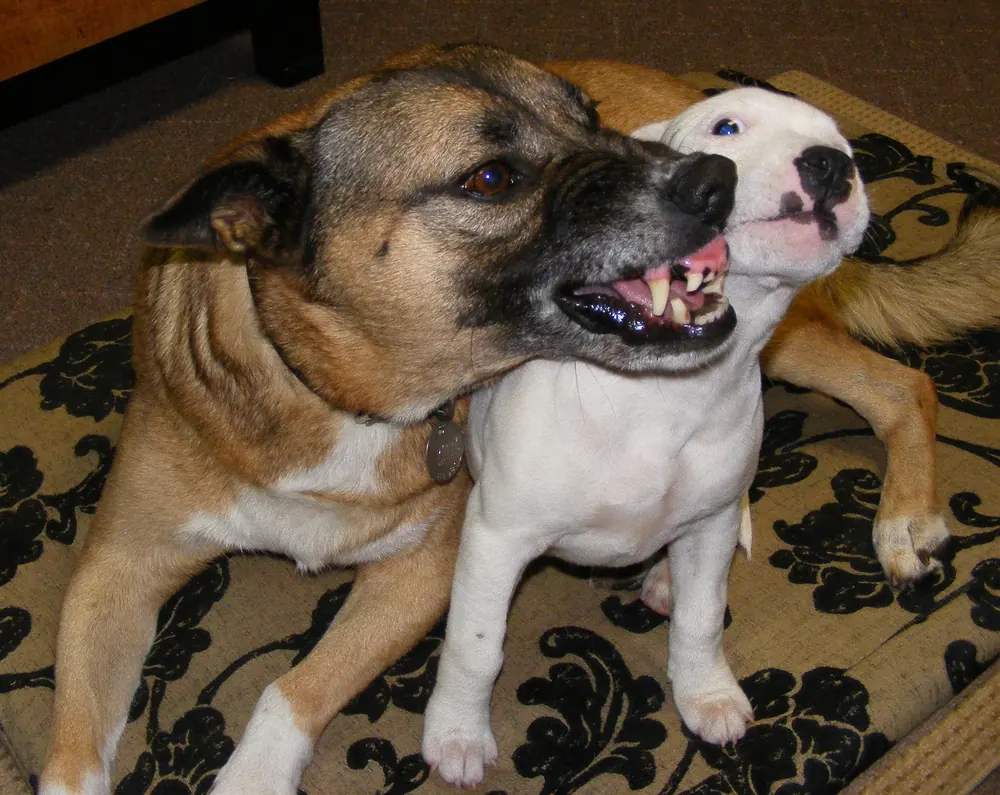
Rough play can look and sound scary, and stepping into a game you mistook for a fight can start a real one. Look at the bodies, not the noise.
| Usually play | Usually a fight |
|---|---|
| Loose, wiggly, bouncy bodies | Stiff bodies, weight leaning forward |
| Play bows and silly, exaggerated moves | Hard stare, then a sudden lunge |
| Dogs take turns chasing and being on top | One dog pins the other and keeps it there |
| Short pauses, then they start again | No pauses; one dog tries to escape and can't |
| Growls that sound "noisy" but faces stay soft | Silence, or high-pitched screaming, and a dog that holds on |
If you're not sure, try a quick check: call your dog or gently hold the dog that's on top for a second. If the other dog comes back for more, it was play. If it runs off or hides behind its owner, end the game.
Why shouldn't I grab my dog's collar?
Because that's how most owners get bitten. In the middle of a fight, a dog may bite whatever touches it, including you, without recognizing who it is. That's a redirected bite, and it's not a sign your dog is "bad." Your hands should stay far from both dogs' heads.
What should I try first?
Start with the safest option and move up only if it doesn't work:
| Step | What to do | Why it can work |
|---|---|---|
| 1. Noise | A sharp clap, an air horn, banging something metal | Interrupts the fight for a second, long enough for the dogs to let go |
| 2. Water | A hose, a bucket, a water bottle aimed at the faces | Surprise without touching the dogs |
| 3. Barrier | A board, a chair, a trash can lid, a backpack pushed between them | Separates the dogs and protects your hands |
| 4. Cover | A blanket or jacket thrown over the dogs' heads | Takes away the visual target |
| 5. Wheelbarrow | With two people, each lifts their own dog's back legs and walks backward | Breaks the dogs' footing; last resort, with risk |
How does the wheelbarrow method work?
- You need two people, one for each dog.
- Each person grabs their dog by the back legs, high on the thighs, and lifts the rear like a wheelbarrow.
- Both walk backward at the same time, in a curve, away from each other.
- Keep going until the dogs are separated and out of sight of each other, then leash them.
Pulling dogs apart while one is still biting can make the wound worse. If a dog is locked on, a barrier or water first is better. Even this method carries a risk of a bite, so use it only when the safer options failed.
Hitting, kicking or yelling in a dog's face usually raises the arousal of both dogs, makes the fight last longer and invites a redirected bite. Keep your body back, use objects and water, and think "interrupt and separate," not "punish."
What if I'm alone?
Use noise, water and barriers. If there's a fence or a pole, you can leash one dog and tie it off, then pull the other one away. Don't try the wheelbarrow alone with two dogs. Call for help: other owners at the park often have leashes, water and a free pair of hands.
What should I do after the fight?
- Leash both dogs and keep them apart and out of sight of each other.
- Check your dog for punctures, especially on the neck, legs and ears.
- See a vet the same day if there's any wound. Punctures often look smaller than they are.
- Exchange contact information and rabies vaccine status with the other owner.
- If a person was bitten, follow our guide on what to do after a dog bite at the park.
What should I carry in case of a fight?
You'll probably never need most of this, but it fits in a jacket pocket or a small bag, and it's what turns "I don't know what to do" into a plan.
- A spare leash or slip lead, to leash the other dog if its owner isn't close
- A water bottle with a squirt top
- A small air horn or a whistle for a loud, sudden noise
- A citronella spray made for dogs, which some owners use to interrupt a fight without contact
- Your phone with your vet's number and the closest emergency clinic saved
Look around when you arrive, too. Many parks have a hose, a water spigot or a bench nearby, and knowing where they are saves seconds.
Can my dog go back to the park after a fight?
Usually yes, but not right away and not at the busiest hour. Wait until any wounds heal, then go back at a quiet time, stay near the gate, and leave after a short, calm visit. Watch how your dog reacts to dogs that look like the one in the fight.
If your dog started the fight, or if this wasn't the first time, talk to your vet first. Pain is a common, hidden reason for a short temper. After that, a certified trainer or a veterinary behaviorist can tell you whether the dog park is still a good fit. Some dogs simply enjoy one or two dog friends more than a crowd, and that's fine.
How can I prevent dog fights at the park?
Most fights have warning signs: a stiff body, a hard stare, a dog standing over another, growling that doesn't stop. Leaving early is the easiest way to avoid a fight. Learn the signals in dog body language at the park, and see our dog park etiquette guide for gate crowding, toys and treats, the usual triggers.
Frequently asked questions
What is the safest way to break up a dog fight?
Without touching the dogs: a loud noise, water or a barrier pushed between them. Keep your hands away from their heads.
Should I grab my dog's collar in a fight?
No. A dog in a fight may bite whoever touches it, including its owner.
What is the wheelbarrow method?
Two people each lift their own dog's back legs and walk backward, away from each other. It's a last resort and still carries a bite risk.
Does water stop a dog fight?
Often. A hose or bucket of water to the dogs' faces can interrupt a fight without anyone touching them.
How can I tell rough play from a fight?
Play has loose bodies, play bows, pauses and turn-taking. A fight has stiff bodies, hard stares, no pauses, and one dog trying to get away.
Should I see a vet after a dog fight?
Yes, if there's any wound. Punctures can look small and become infected underneath.
Sources: Great Plains SPCA, guidance on safely breaking up a dog fight; Psychology Today, articles on breaking up dog fights and redirected aggression; ASPCA guidance on aggression in dogs. This guide is general information; if a person is hurt, seek medical care.