Close the room, or put a gate across it, whenever you cannot watch, and teach the cue somewhere else before the tree goes up. A dog that has never been asked to leave a single object will not invent that skill because the object is now a tree with lights.
In this guide
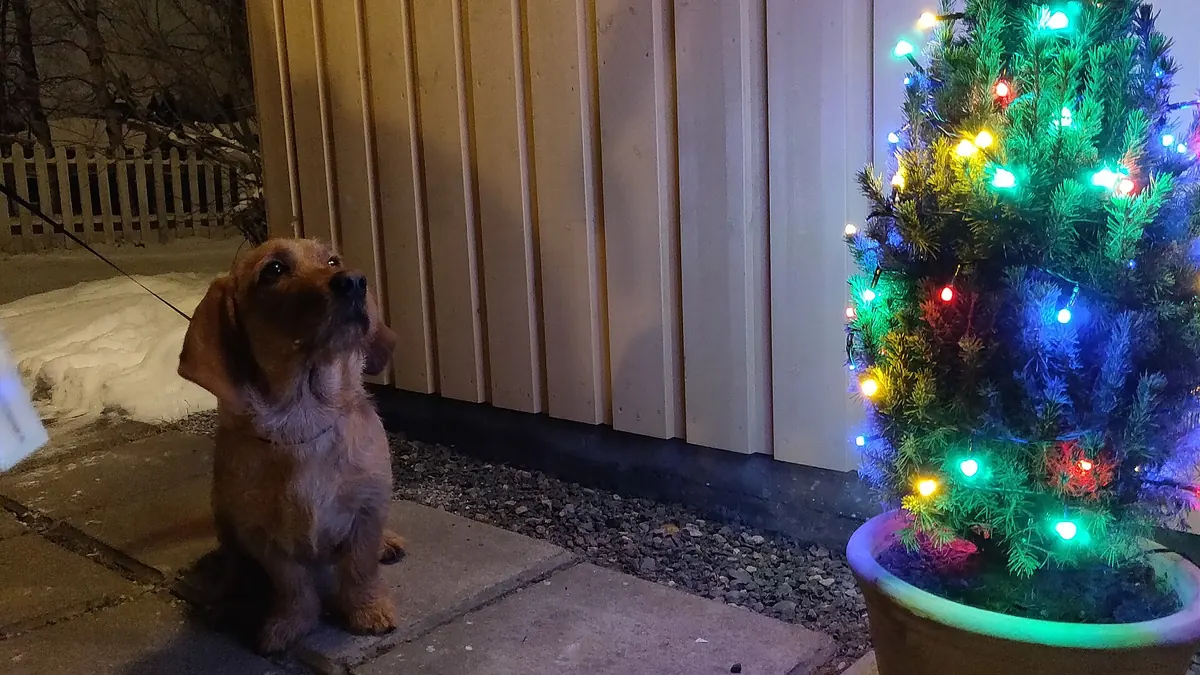
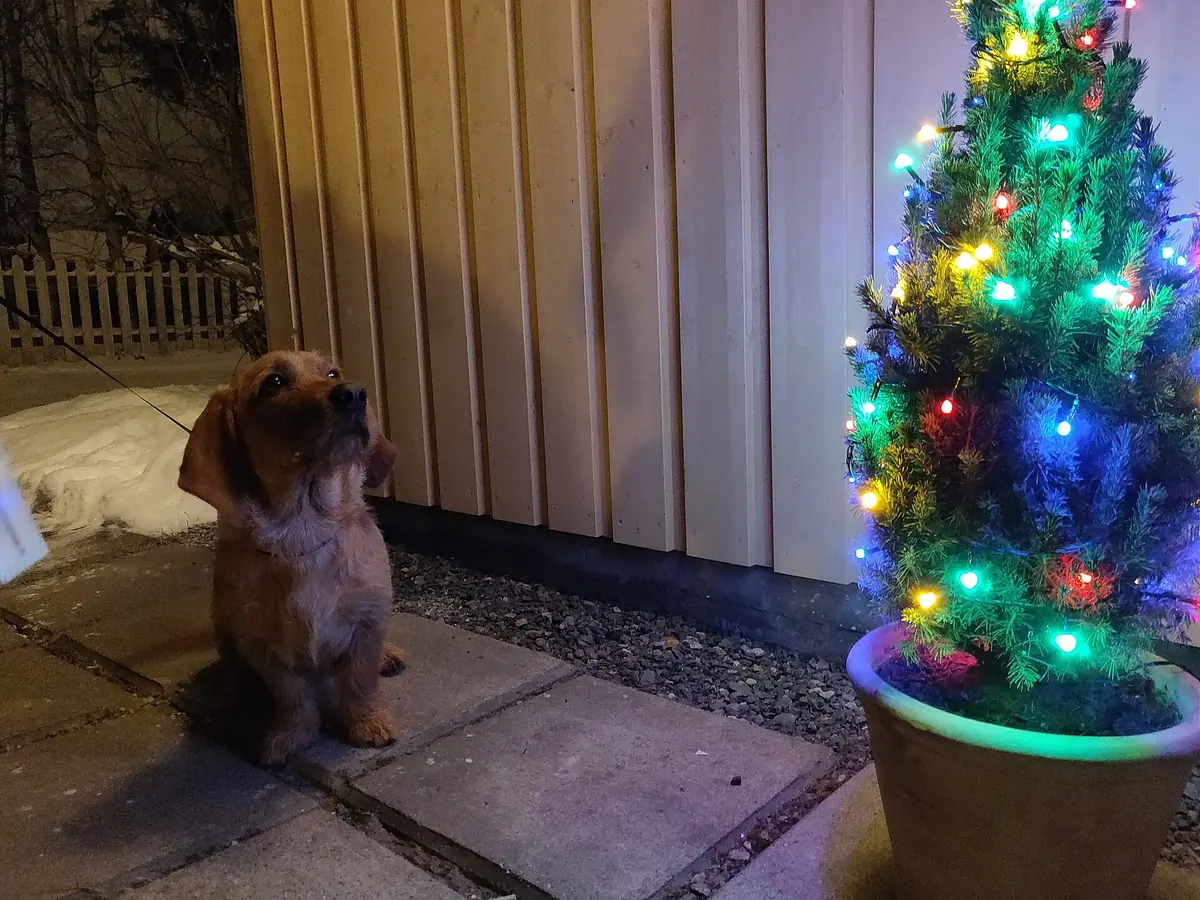
The photo of a dog staring at a lit tree is the moment the plan either exists or does not. Staring is not yet pulling a branch. It is also not proof the dog will keep the distance when you leave for the groceries. Management is the part that works on day one. Training is the part that lets you open the door later without holding your breath.
What do you set up before the tree comes inside?
Decide which room the tree lives in, and decide how that room closes. A door that latches is the simplest. A pressure gate fails if the dog is tall enough to knock it or small enough to slip under, so test it with the dog before any ornaments are on the tree. If the tree has to stand in a room you cannot close, the crate, a pen, or a tether you already use becomes the plan for every minute you are in another room or asleep. "We'll just watch him" is not a plan for a shower.
Move the tree's water, the skirt, and anything that dangles at nose height out of reach or out of the design. Edible ornaments, popcorn strings, and chocolate are training problems and household problems at the same time. This article does not list toxins or doses. If a dog eats something and you are worried, call a veterinarian. The behavior goal is narrower: the tree is not a toy, a snack, or a bed.
What cue do you teach, and where?
Use a cue the dog already finds easy, in a boring room, with the tree still at the store or still outside. Leave it is the one most people need: the dog turns away from an object because turning away pays. Practice on a shoe, then a box, then a plain branch on the floor. The tree, fully decorated, is the final picture, not the first lesson. If "leave it" is still shaky on a shoe, it will fail on tinsel, and the failure teaches the dog that the tree pays off.
The ASPCA's bite-prevention page is useful here for a different reason than bites. It describes what a relaxed dog looks like, and what an anxious or loaded dog looks like. Calm is a loose body, ordinary breathing, a wag that matches a loose spine. Anxious dogs make themselves smaller: crouch, lick lips, turn the head, tuck the tail, flatten the ears, yawn, go still. An aggressive display goes the other way: tall, stiff, weight forward, staring, hair up, teeth, a growl. A dog at the tree that suddenly goes still and stares is not "being good." That is one of the signals on that page. End the session. Open distance. Do not narrate it as a cute standoff for a photo.
| Before the branches are indoors | After the tree is up |
|---|---|
| Pick the room and test the door or the gate with the dog | Tree access only when a person is in that room and watching |
| Practice leave-it on dull objects | Ask for the cue at the doorway, then pay the dog away from the tree |
| Choose a crate or pen for unsupervised minutes | Those minutes include showers, cooking, and overnight |
| Skip edible hangings in the plan | If something is eaten, call a veterinarian. Do not wait to see if the cue sticks. |
How do you handle the first hour the lights are on?
Leash the dog in the house for that hour if you do not trust the recall. A leash indoors sounds odd and works. You can step on it or hold it while you adjust a branch, which beats lunging across a stand full of water. Ask for a sit or a down on a mat placed several feet from the lowest branch. Pay that mat often, in the first hour, so the mat is more interesting than the pine. Then release the dog to sniff once, call the dog back, and pay the return. One sniff you allowed is different from a dog who self-serves the whole skirt.
The ASPCA's notes on play that gets too hard use a short time-out: stop, and if you need to leave, leave for 10 to 20 seconds, and do not run that correction in a tight loop. They cap one mouthing drill at three repeats inside 15 minutes. That drill is for mouthing a hand at home. It is not a recommended length for a dog-park visit, and it is not a license to yank a dog off a tree three times and call the evening a success. If you are repeating the rescue, the room is still open and the setup is wrong. Close it.
What do guests get wrong?
Guests turn the tree into a party trick. They call the dog over, they hang a treat on a branch as a joke, they say the dog is fine because the dog sat for a photo. You are the person who lives there after they leave. Tell guests the tree is off limits before they sit down. A dog who is fed from the branches will check the branches tomorrow when the house is quiet. The same problem shows up at a park when people bring food into a crowd. Treats at the dog park is the public version. At home, you can ban the joke without a city ordinance.
If a guest is afraid of the dog, the tree room is a bad place to solve that. Guests who are afraid of dogs need a separate plan: a closed door and a dog who is not performing. Do not park a nervous person and a curious dog on the same rug as the lowest ornaments.
- Latch or gate tested with your dog, before ornaments.
- Leave-it practiced on something boring.
- Mat or bed placed away from the trunk, paid while you decorate.
- No edible ornaments. No popcorn rope.
- Leash on for the first decorating session if the dog is a puller.
- Guests told, out loud, not to feed the tree.
- When you sleep, the dog is not in the open tree room.
That is the whole unsupervised rule. A baby gate you have not tested, a cracked door, and "he usually doesn't" are the same failure. Close the latch. If the dog eats an ornament or drinks the stand, skip the training debrief and call a veterinarian.
When is the tree a lost cause for this year?
If the dog has already rehearsed success, knocking the stand or stealing a decoration, and you cannot close a room, take the tree down or move it to a room that does close. One more week of practice while the tree stays up teaches the wrong lesson faster than a closed door teaches the right one. You can put the tree back up next year after the cue is dull and reliable in November, which is earlier than the weekend you drag the box out of the attic. Card photos can happen on the mat, with the tree in the background and the leash out of frame, during a minute you are actually watching. They should not be the first time the dog meets the tree.
A foster dog in the house for a holiday week is a poor candidate for a decorated room. Holiday fostering works better if the tree room stays shut for that dog's entire stay. You do not know that dog's history with shiny objects, and you will not build a reliable leave-it in three days of relatives.
Frequently asked questions
How do I keep my dog out of the Christmas tree?
Close the room when you cannot watch, and teach leave-it away from the tree before you decorate. The first hour can be on a leash, with a mat paid several feet from the trunk.
Can I train this with the tree already up?
You can practice in another room. Using the finished tree as the classroom rewards the dog for being next to it. If the dog is already winning, close the room.
Is staring at the lights a problem?
Staring and sudden stillness are on the ASPCA's list of signals to take seriously, not a pose to extend for a photo. Ask for the cue or end access.
What if the dog eats an ornament?
Call a veterinarian. This page is about access and cues. It is not a treatment guide.
Should guests help by offering treats at the tree?
No. Feeding from the branches teaches the dog to check the tree later. Tell guests before they try to be funny.
Sources: ASPCA, Dog Bite Prevention (aspca.org/pet-care/dog-care/dog-bite-prevention), body-language descriptions used here as a reason to end a tree session; ASPCA, Mouthing, Nipping and Play Biting in Adult Dogs, the 10-to-20-second time-out and the cap of three repeats in 15 minutes, cited only as a home drill and not as a park or tree schedule. Training steps for "leave it" are expanded in Pawnauta's leave-it guide. If a dog ingests a decoration, contact a veterinarian.