Most of the time, no. The ASPCA's guidance on leash reactivity says friendly off-leash dogs greet in an arc, with soft eyes and a sniff, while two leashed dogs on a sidewalk are pushed into a head-on approach, tight collars and direct eye contact, which is exactly the setup that turns a hello into a lunge.
In this guide
A greeting can still be the right call when both dogs are loose in their bodies, both handlers have a plan, and there is enough space to let them curve instead of collide. That is a chosen meeting, not the default every time two leashes pass on a sidewalk. The dog park is the place built for off-leash greetings. The sidewalk is the place built for passing.
Why does a leash change the greeting?
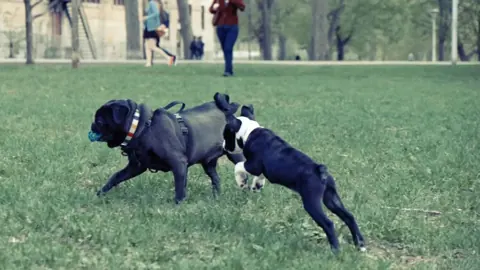
The ASPCA walks through the contrast in its handout on dogs who are reactive on leash. Off leash, sociable dogs usually approach in an arc, come together gradually, wag, circle, and sniff faces and then hindquarters before they decide to play or move on. The dog that skips the ritual and barges in is the one that starts the arguments.
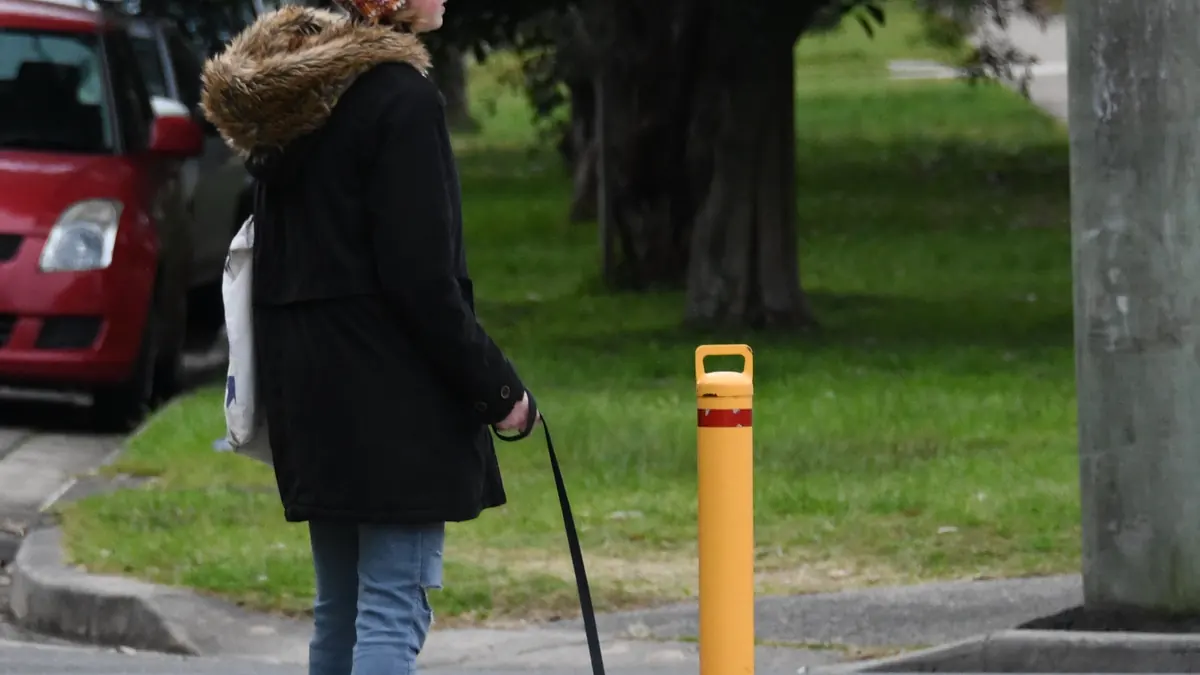
On a sidewalk the geometry is worse. The dogs are aimed at each other. They make direct eye contact. Both are often pulling, so the collar tightens, and a tightening collar adds tension. Handlers get nervous and jerk the leash or mutter "be nice," which the dog reads as confirmation that this is a threat. The ASPCA's point is that the explosion at the end of that sequence is not a mystery. The leash removed the arc.
If you want the greeting dogs actually use, you need space for a curve, or you skip the greeting. A tight sidewalk, a doorway, and the gate of a dog park are the three places where that space disappears first.
When is a leashed greeting a reasonable yes?
Say yes only if every line below is true. One missing line means you pass.
- Both handlers agree out loud before the dogs are close. A smile is not a yes.
- You can step off the traffic line so the dogs can approach on a curve, not nose to nose in a corridor.
- Both leashes stay loose. A taut leash is already a no.
- Both dogs look soft: loose mouth, wagging that includes the whole body, no stare, no still tail. The ASPCA describes the friendly off-leash version as soft-eyed and gradual. Use that picture.
- Either handler can end it in one second by stepping away, and both will.
- Neither dog is in a doorway, on a staircase, or in the double-gate of a dog park. Those are choke points. See dog park etiquette for why the gate is the worst place to socialize.
Two seconds of sniffing and then a cheerful split is a successful greeting. Circling until a leash wraps a pair of legs is the meeting going on too long. End it while it is still easy.
When should you pass instead?
Pass when the other handler does not answer, when either dog is barking or staring, when you are on a narrow sidewalk with people behind you, or when your dog has a history of lunging once the other dog is in range. The ASPCA says avoidance is a reasonable way to live with leash reactivity, including walking at quiet hours, crossing the street, or doing a U-turn. Skipping one greeting does not undo socialization. Practicing lunges does.
The handout splits leash-reactive dogs into two motives, and the pass looks the same for both. Some dogs fear other dogs because of a bad meeting or thin socialization, and the bark keeps the other dog away. Some dogs like other dogs so much that the leash becomes frustration. Both groups get better at the outburst if they rehearse it. The management step is to create distance before the bark starts, then reward the quiet pass. For the body signals that tell you which moment you are in, see body language at the park.
What do you do in the three seconds you have?
You usually see the other dog too late for a training session and early enough for a choice. Use a short script.
- Look at your dog's body before you look at the other handler. A freeze, a hard stare, or a leash that has already gone tight means you are creating distance, not chatting.
- If you need distance, cross the street, step between parked cars, or turn around. The ASPCA lists those moves by name. Say where you are going in a normal voice so your dog follows the turn instead of the other dog.
- If you are going to pass close, feed before the bark. The ASPCA says to put tasty food at the dog's nose and let the dog nibble while the other dog goes by. Some dogs do better if you stop and sit them. Some do better if you keep walking. Reward the choice not to bark.
- If both people want a greeting and the checklist above is intact, let the leashes slacken and give the dogs a curve. Count a few sniffs. Then call your dog and leave. Do not wait for the first growl to be the cue.
Do not wrap the leash shorter and drag the dog into the other dog's face to "get it over with." That is the head-on approach the handout says produces the fight. Do not yell the dog's name as a threat. A name should mean "look at me," which only works if looking at you pays.
What about the dog park gate?
Inside the fence, dogs are supposed to be off leash so they can use the arc. On the outside of the gate, and in the double-gate vestibule, they are on leash and trapped in a small box with every dog that wants to inspect the newcomer. That is the sidewalk problem with walls. If your dog is already inside, move away from the gate when someone arrives, which is the courtesy the Sacramento SPCA also writes into its etiquette notes: the entrance is highly charged, and dogs already in the park should be walked off the gate so the new dog is not mobbed.
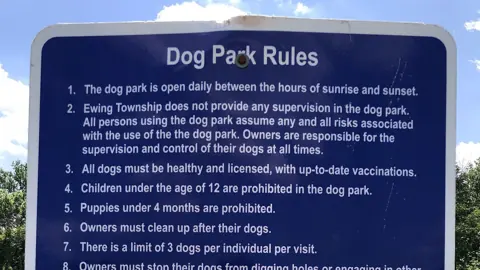
Unclip in the vestibule only when the outer door is shut and the inner door is about to open, and only if the park's own sign allows it. Some parks tell you to unclip before you enter the play yard so the dog is not dragged in on a tight line. Follow the sign at that park. The principle is the same either way: do not hold a tight leash in a crowd of loose dogs. A leashed dog cannot leave, and the ASPCA's whole warning is that the inability to leave is what raises the tension.
It is either locked short, which is a tight collar, or paid out, which lets your dog reach a dog whose handler never agreed. For a pass or a greeting, use a regular leash you can keep loose or shorten on purpose. More on that tool is in retractable leashes at dog parks.
How do you practice the pass so the greeting stays optional?
The ASPCA's management list is the practice plan, and it is deliberately boring. Walk at times when other dogs are scarce if your dog is already explosive. Teach a U-turn that means food, not panic. Reward every quiet pass with something better than the other dog. If a head halter helps your dog look at you, the handout allows it only while you are supervising, and only with rewards for not barking.
If the quiet cue and the food-on-the-nose pass still fail after repeated tries, the same handout says to get a qualified trainer or behavior professional rather than inventing a harsher correction. Yelling, leash pops and forcing the greeting teach the dog that other dogs predict a fight with you in the middle. That is the outcome you are trying not to rehearse.
Puppies are not an exception to the geometry. A short, loose, agreed sniff can be part of socialization. A daily series of head-on sidewalk crashes is how a friendly puppy learns the lunge. Quality of meeting beats number of meetings. One calm pass is a better lesson than five tangled ones.
Frequently asked questions
Should dogs greet each other on leash?
Usually no. The ASPCA says on-leash meetings force a head-on approach and tight collars, unlike the curved greeting dogs use off leash. Greet only when both people agree and there is room to keep the leashes loose.
My dog is friendly at the dog park but barks on the sidewalk. Why?
The ASPCA says some dogs only react when the leash removes their ability to approach normally. Frustration and fear can look the same from the other end of the leash. Distance and a paid-for pass come before more greetings.
Is it rude to refuse a greeting?
No. A clear "we're going to pass" is the polite version. You do not owe a stranger's dog access to your dog's face.
What if the other dog is already in our space?
Shorten the moment. Step off the line, put your body between the dogs if you can do it calmly, and leave. Do not stand and scold your dog while the other dog is an inch away. That is still a head-on meeting.
Can I fix this by letting them "work it out" on leash?
The ASPCA's description of the barging dog is the one that gets into fights. Letting two tight leashes work it out rehearses the fight. Give them an arc off leash in a suitable place, or skip it.
Sources: ASPCA Pro, "Dogs Who Are Reactive On-Leash" (aspcapro.org PDF), on curved greetings, head-on sidewalk meetings, avoidance, U-turns and food during passes; ASPCA, Barking (aspca.org), on greeting barking versus alarm barking, used for the body cues around a hello; Sacramento SPCA dog-park etiquette notes, on moving dogs away from the entrance gate. This is training guidance from those organizations, not a diagnosis of any individual dog.