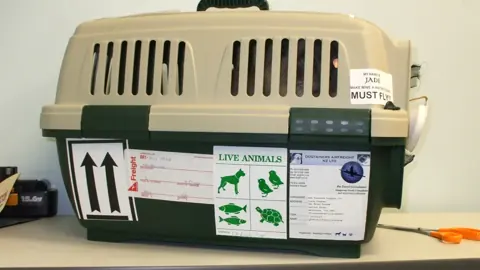
When you take your dog to another US state, the destination state sets the rules, not the federal government. Most states require a current rabies vaccination, and many require a health certificate, officially a Certificate of Veterinary Inspection (CVI), signed by a USDA-accredited vet, usually within about 30 days before entry. In practice, owners driving in for a visit are rarely checked, but you should carry the paperwork anyway. Airlines often have their own, stricter rules.
In this guide
- What is a CVI?
- What do states usually require?
- Do airlines have different rules?
- How does Hawaii's dog entry program work?
- What about moving to a new state?
- Does my dog need extra vaccines for some regions?
- Can my dog ride a train or bus across state lines?
- Do I need a local dog license when I visit?
- What should I carry on a trip?
- Do national parks and forests have rules too?
- What about Canada or Mexico?
- Frequently asked questions
The USDA says it doesn't regulate owners moving their pets between states. It points travelers to each state's requirements.

What is a CVI?
A Certificate of Veterinary Inspection, often called a health certificate, is a form in which a vet records that your dog was examined and showed no signs of contagious disease, along with vaccine information. It has to be signed by a vet accredited by the USDA. Ask your vet in advance; not every clinic has an accredited vet on staff.
Many vets now issue certificates electronically, which states can verify faster. The visit itself is a regular exam plus the paperwork, so expect to pay for both, and ask for a few printed copies: one for the glove box, one for your carry-on and one to leave with whoever cares for your dog at the destination.
If your dog's rabies vaccine is due soon, get it done before the certificate visit. A certificate is only as good as the vaccine record on it, and a vaccine that expires during the trip can cause problems if you need a vet or are asked for proof after a bite.
What do states usually require?
| Requirement | How common |
|---|---|
| Current rabies vaccine and certificate | Required by most states |
| Health certificate (CVI) | Required by many states, often issued within about 30 days |
| Tests or treatments | Some states, in specific cases |
| Strict entry program | Hawaii, which is rabies-free, has a detailed rabies quarantine program |
Rules change, and some states don't accept every form. The USDA APHIS pet travel website has a state-by-state lookup. When in doubt, contact the destination State Veterinarian's office.
Do airlines have different rules?
Often, yes. Many airlines require a health certificate issued within a short window before the flight, commonly 10 days, especially for dogs in cargo. Check your airline's pet policy before you book. See flying with a dog.
How does Hawaii's dog entry program work?

Hawaii is rabies-free and protects that status carefully. Dogs that meet every requirement of its "5-Day-or-Less" program can be released directly at the airport. The main steps, according to the Hawaii Department of Agriculture and Biosecurity, include two rabies vaccinations within the required timeframe, a passing rabies antibody blood test (called FAVN), and a waiting period of at least 30 days after that test before arrival, plus paperwork sent ahead. Dogs that don't meet all the requirements can be quarantined for up to 120 days. The blood test alone can take weeks to process, so start planning months ahead, not weeks.
What about moving to a new state?
Moving adds local rules on top of the entry rules. Your new city or county will likely require a dog license, and the rabies vaccine schedule may follow local law. Some cities also have breed or number-of-dogs rules. See moving to a new city with a dog and dog license fees by city.
Does my dog need extra vaccines for some regions?
The entry rules only cover the basics, but disease risks change from region to region. A dog heading to the Northeast or upper Midwest may meet many more ticks carrying Lyme disease, and a trip to a wet, warm area or a lake house raises the leptospirosis risk. Tell your vet where you're going at the certificate visit; it's the perfect moment to check tick prevention and the lepto vaccine. See ticks on dogs and leptospirosis in dogs.
Can my dog ride a train or bus across state lines?
On Amtrak, small pets can travel on many routes: the pet and its carrier together can weigh up to 20 pounds, trips are generally limited to 7 hours including transfers, each customer can bring one pet, and there's a fee per segment. Larger dogs can't ride except service animals. Intercity bus lines generally allow only service animals, so check before you buy a ticket. Train or bus, carry the same paperwork you'd bring in a car.
Do I need a local dog license when I visit?
Usually not for a short visit. City and county dog licenses are meant for dogs that live there, and many places give visitors a grace period before a license is required. Your dog should still wear its home license and rabies tags, since they're how a shelter traces a lost dog back to you. If you stay for months, for example as a snowbird, check the local rule.
What should I carry on a trip?
- Rabies certificate (not just the tag)
- Health certificate, if required
- Vaccine records and any medication list
- Microchip number and the registry's phone number
- A recent photo of your dog, in case it gets lost
Do national parks and forests have rules too?
Yes, but they're about leashes and where dogs can go, not entry paperwork. National parks require leashes no longer than 6 feet where pets are allowed. See dog-friendly national parks and hiking with dogs in national forests.
What about Canada or Mexico?
International trips are a different process, and coming back into the US has its own CDC rules. See bringing a dog into the US.
Frequently asked questions
Do I need a health certificate to drive my dog to another state?
Many states require one, usually issued within about 30 days, but enforcement for owners driving in is rare. Carry it to be safe.
What is a CVI for dogs?
A Certificate of Veterinary Inspection: a health certificate signed by a USDA-accredited vet.
Who sets the rules for taking a dog to another state?
The destination state. The USDA APHIS website lists each state's requirements.
Does my dog need a rabies vaccine to cross state lines?
Most states require a current rabies vaccination for dogs entering the state.
How long does it take to bring a dog to Hawaii?
Plan on months. Dogs need two rabies vaccines, a passing rabies antibody test and at least 30 days of waiting after that test to qualify for release at the airport. Otherwise, quarantine can last up to 120 days.
Can I take my dog on Amtrak to another state?
Small dogs can ride on many Amtrak routes if the dog and carrier together weigh 20 pounds or less and the trip is 7 hours or shorter. There's a fee, and only one pet per customer.
How long is a dog health certificate valid?
It depends on the state and airline; 30 days is common for states, and many airlines want one within 10 days of travel.
Sources: USDA Animal and Plant Health Inspection Service, "Take a Pet From One U.S. State or Territory to Another" and the APHIS pet travel state lookup (aphis.usda.gov); State of Hawaii Department of Agriculture and Biosecurity, rabies quarantine and 5-Day-or-Less program (dab.hawaii.gov); National Park Service pet rules. Requirements change; confirm with the destination state and your airline before you travel.