Skijoring is allowed only where the land manager has said so. On the Superior National Forest, the Forest Service says it is not allowed on most groomed cross-country trails, because dog prints and feces wreck the track, and it publishes a short list of trails that are open. Wisconsin's DNR says skijoring is not allowed on designated cross-country ski trails or nature trails, and is allowed on non-designated ski trails and off trail where dogs are allowed, on a line no longer than 8 feet. Minnesota's DNR says skijoring is not allowed on any state trail groomed for skiing.
In this guide
A video of a skier behind a dog is not a trail permission. The permission is the forest, state, or city page for the exact path under your skis.
What does the Superior National Forest allow?
The forest's winter-sports page, updated October 13, 2026, defines skijoring as one dog pulling a person on skis, and mushing as a team pulling a sled. It says skijoring is usually tied, in people's minds, to a groomed ski trail, and that is exactly where it is usually banned. The page asks people who do use a designated trail to pick up feces and repair damaged classic tracks, as proof the two sports can share ground. It lists trails open to mushing or skijoring, including the North Arm Trail, George Washington Pines, the Massie-Hall and Norpine system, North Junction, Trezona, Lutsen Mountains, and the Sugarbush trails (Britton, Moose Fence, Oberg). It tells you to read each trail's own page, because mushing and skijoring are not legal on the same ground everywhere.
George Washington Pines is the beginner example. The forest says it is 3.3 kilometers, about 6 miles up the Gunflint Trail from Grand Marais, shared by classic skiers, skate skiers, snowshoers, hikers, and people skijoring. It does not require the Great Minnesota Ski Pass. Pets must not foul the groomed track. If you are skijoring, remove droppings and repair holes melted into the trail. Skiers are asked to call out so they do not spook dogs. The Tofte and Grand Marais office hours printed on that page run October 1, 2026, to April 30, 2027, Tuesday through Thursday. Call if a connector is closed. The page itself mentions a connector to Norpine that has been a problem in past seasons, and the sentence was incomplete in the extract we read, so do not assume every spur is open.
What do Wisconsin and Minnesota say on state land?
Wisconsin DNR's dog-powered sports page says the word comes from a Norwegian term for ski-driving, and then it sets the limit: not on designated cross-country ski trails, and not on nature trails. A trail is designated if the use is on the map or on a sign at the trailhead. Where it is allowed, on non-designated ski trails and off trail on properties that allow dogs, the line or leash may be no more than 8 feet. The DNR says to call the park or forest office about the specific property. An 8-foot line is a measured rule. A 20-foot gangline you saw in a race is not what that page allows on state land.
Minnesota DNR's state-trail rules say dogsledding or mushing is not allowed on state trails except by special-use permit, and skijoring is not allowed on any trail groomed for skiing. Separately, pets on Minnesota state trails must be on a lead of 6 feet or shorter. Verbal control is not enough. Those are two different sentences. A skijor line that is illegal on a groomed ski trail does not become legal because you shortened it to 6 feet. The ban is the use, not the length. Trail etiquette covers waste and yielding. It does not overrule a groomed-trail ban.
Where has a city written the yes in advance?
The City of Superior, Wisconsin, publishes skijoring on its municipal-forest ski page. It says the forest has 27.78 kilometers of groomed trails. Skijoring is described on the Orange Trail, a 7.4 kilometer loop on Chase's Point that the city says is not regularly groomed by staff and is shared with motorized traffic, reached off Highway 105. The page also allows skijoring on the multi-use Alder/Adoop trail, the Millennium Trail, snowmobile trails, and Billings Drive, which is also a snowmobile trail. Sled-dog teams are allowed on designated snowmobile trails. The safety lines are practical: bright clothing, stay right, watch for snowmobiles. A yearly or daily ski permit is required to ski in the municipal forest. Dogs are permitted on skijoring trails only, not on the groomed classic tracks that are not on that list.
That is one city with a map. It is not a Wisconsin statewide yes. The DNR ban on designated ski trails still sits underneath any forest that has not done what Superior did. Ski resorts are another category. A resort that bans dogs from the gondola has not created a skijor loop by accident. Read the resort page before you clip a dog into a harness in a parking lot.
What should a beginner actually change about the plan?
Pick a trail that names skijoring, not a trail that names classic skiing and looks empty. George Washington Pines is named. A random blue loop in a state park is not, until the office says the loop is non-designated and dogs are allowed. Carry bags. The Forest Service asks you to repair the track, which means you need to notice the hole, not ski past it. Call out before you overtake a skier, because the forest asked skiers to do the same for dogs and the courtesy runs both directions. Keep the line inside the length the land manager printed. Eight feet in Wisconsin is a number, not a style.
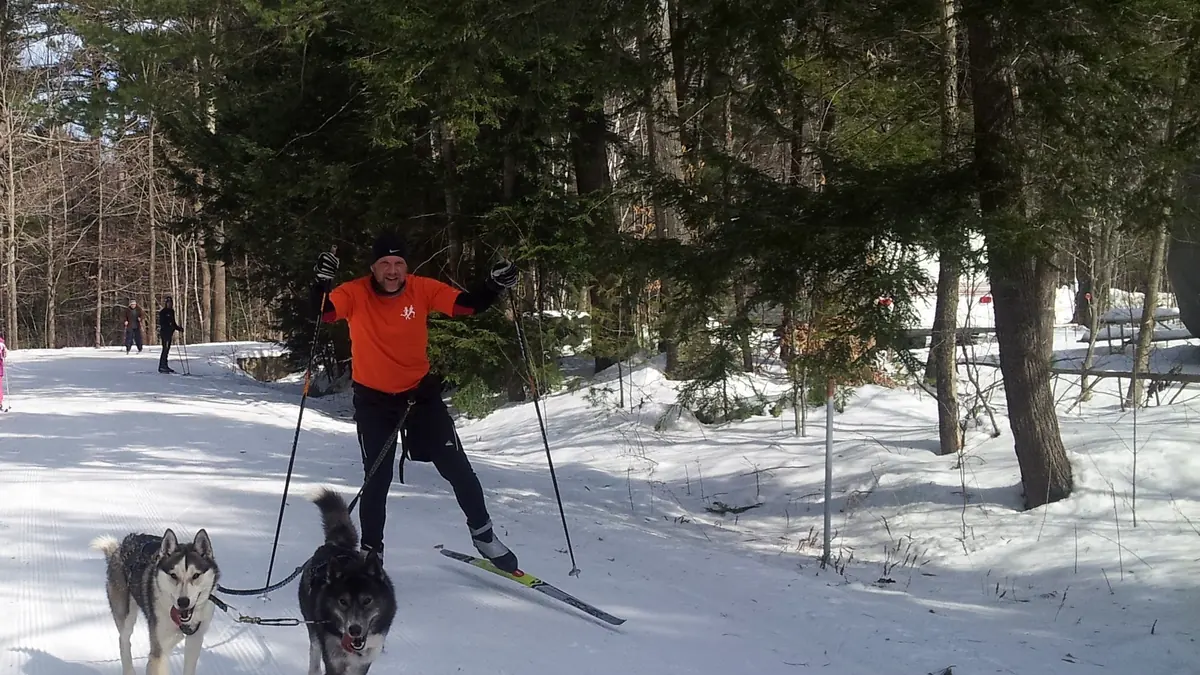
Do not start on a snowmobile trail unless that trail is one of the designated shares. Superior's Orange Trail warning exists because machines and dogs meet at closing speed. The Forest Service says the same about mushing on snowmobile routes in the Superior National Forest: operators may be moving at speeds up to 50 mph with limited sight and hearing. A beginner loop next to Grand Marais is a different risk from a shared snowmobile corridor. Use the first one until the dog knows the job. The cover photo is skijoring at Gunstock in New Hampshire. The photo inside this article is a National Park Service file that does not name a park. Neither picture is a trail this article is authorizing.
| Land | Skijoring | Number to remember |
|---|---|---|
| Superior National Forest groomed ski trails | Not on most of them | Page updated October 13, 2026 |
| George Washington Pines | Yes, shared with skiers and snowshoers | 3.3 km, no Great Minnesota Ski Pass |
| Wisconsin designated ski trails | No | 8-foot line where it is allowed |
| Minnesota groomed state ski trails | No | Pets otherwise on a 6-foot lead |
| Superior, Wisconsin, named trails | Yes, including a 7.4 km shared loop | Ski permit required in the municipal forest |
- Start with a trail that uses the word skijoring. George Washington Pines and Superior, Wisconsin's named trails do.
- Stay off groomed classic tracks unless the page puts you there. Superior National Forest and both state DNRs restrict that use.
- In Wisconsin, if you are in a legal spot, keep the line at 8 feet or less. Call the property if you are unsure it is non-designated.
- Pick up and repair melted holes. That is the Forest Service condition for sharing a designated trail.
- On anything shared with snowmobiles, wear high-visibility clothing and assume the machine cannot see the dog.
- A resort ban on pets is still a ban. Do not clip in at a ski area that has not published a skijor trail.
The Forest Service, the Wisconsin DNR, and the Minnesota DNR all restrict skijoring on groomed or designated ski trails. The yeses are listed trails and non-designated ground where dogs are already allowed. "It was early and nobody was out" is not one of the exceptions.
Frequently asked questions
Can beginners skijor on a cross-country trail?
Only if that trail allows it. The Superior National Forest says skijoring is not allowed on most groomed ski trails and lists exceptions, including George Washington Pines near Grand Marais. Wisconsin bans it on designated ski trails. Minnesota bans it on state trails groomed for skiing.
How long can the line be?
Wisconsin DNR says no more than 8 feet where skijoring is allowed. Minnesota's general state-trail pet rule is a 6-foot lead, and that length does not make skijoring legal on a groomed ski trail. Use the number for the land you are on.
Do you need a ski pass?
George Washington Pines does not require the Great Minnesota Ski Pass. The City of Superior, Wisconsin, requires a daily or yearly ski permit in the municipal forest. Read the trail page. They are not the same state.
Are dogs allowed on every snowmobile trail?
No. The City of Superior names specific shared trails. The Superior National Forest tells mushers to ask the ranger district which roads and which multi-use trails are open, and it warns that snowmobiles may be traveling up to 50 mph.
Is the sport allowed at a ski resort?
Only if that resort's own page says so. A resort rule about dogs on lifts is not a skijor permit. Use the resort guide and the resort's current pet page.
Sources: USDA Forest Service, Superior National Forest winter sports, updated October 13, 2026, including the definition of skijoring, the ban on most groomed ski trails, the open-trail list, and the snowmobile caution; George Washington Pines Winter Recreation Trail page, 3.3 km, no Great Minnesota Ski Pass, shared use, and the cleanup and repair rules; Wisconsin DNR, dog-powered sports, skijoring banned on designated cross-country and nature trails, 8-foot line where allowed; Minnesota DNR state-trail rules, skijoring banned on trails groomed for skiing, mushing by special-use permit only, pets on a lead of 6 feet or shorter; City of Superior, Wisconsin, cross-country skiing and skijoring page, 27.78 km of groomed trails, Orange Trail 7.4 km, the other named skijor routes, ski permit, and dogs on skijor trails only. The National Park Service photograph does not name a park and is not a permit. Confirm closures with the ranger district.