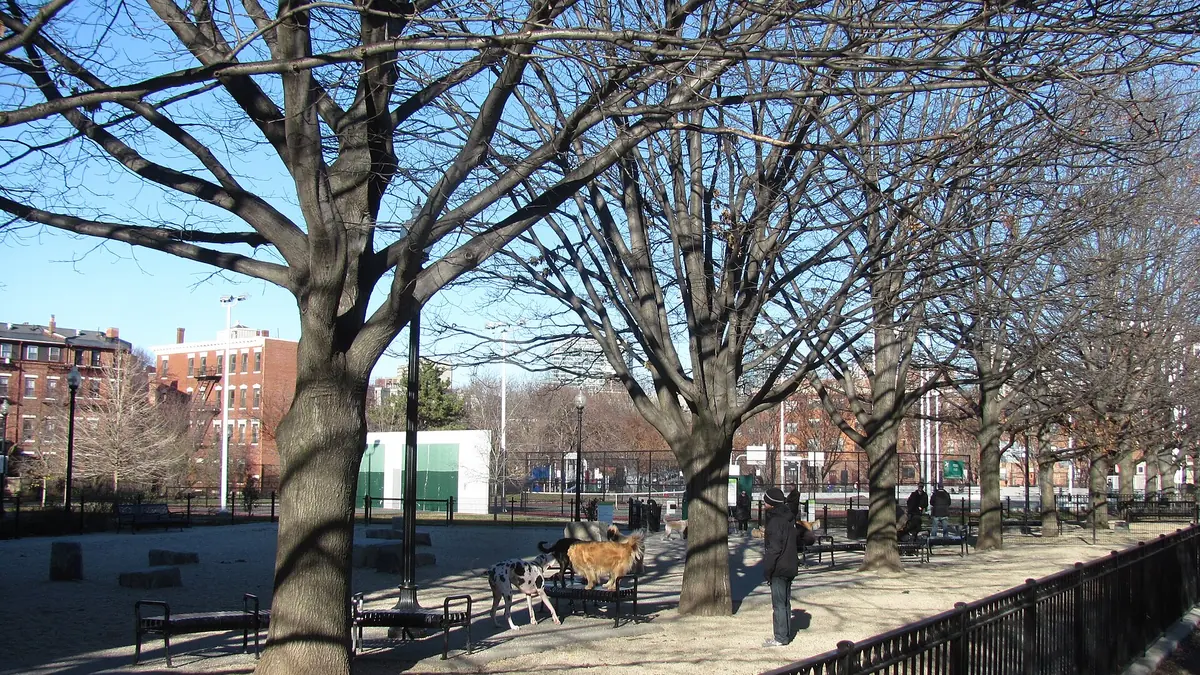
Boston has very few official off-leash areas for a city its size. Boston Parks and Recreation lists five designated Dog Recreation Spaces — three in Dorchester, one in the South End and one in the North End — plus a dog park at Smith Playground in Allston and a rotating off-leash area on Boston Common. Everywhere else in city parks, dogs must be on a leash of up to eight feet, and every Boston dog over six months old needs an annual city license.
In this guide
- Boston's official off-leash spaces
- Boston Common: the rotating off-leash area
- Where dogs can't go
- Boston dog license: what you need
- Scoop the poop: it's the law
- What's next: Franklin Park
- Beyond city parks
- Boston seasons and your dog
- How Boston's rules compare
- Beyond the dog parks: on-leash walks
- Your first visit checklist
- Frequently asked questions
This guide lists each official space, explains how the Boston Common rotation works, and covers the licensing and cleanup rules the city actually enforces.
Boston's official off-leash spaces
| Dog Recreation Space | Address | Neighborhood |
|---|---|---|
| Peters Park | 230 Shawmut Avenue | South End |
| DeFilippo Playground | 135 Prince Street | North End |
| Downer Avenue Playground | 40 Downer Avenue | Dorchester |
| Garvey Playground | 340 Neponset Avenue | Dorchester |
| Ronan Park | 92 Mt. Ida Road | Dorchester |
| Smith Playground | 235 Western Avenue | Allston |
| Boston Common (rotating) | Lawn sections of the Common | Downtown / Beacon Hill |
Smith Playground's dog park opened as part of the park's Phase 2 renovation, with two separate areas so dogs of all sizes can play safely. It's the only official space serving Allston and Brighton.
Boston Common: the rotating off-leash area
Boston Common has an off-leash space that moves between lawn sections of the park. The rotation gives each lawn time to recover — the Common gets enormous foot traffic, and turf worn down by dogs needs rest.
The parcels are managed by Common Canine, a sub-group of the Friends of the Public Garden. To find the current location:
- Look for the signage on the Common — and for the other dog owners.
- Check the current parcel map on Common Canine's webpage before you go.
Off the designated parcel, the Common follows the normal leash rules, and the Public Garden next door is a separate, leash-only space.
Where dogs can't go
Boston's parks rules keep dogs out of any area designated for children, leashed or not:
- Tot lots and play areas
- Sandboxes
- Ball fields
- Other fenced areas
Outside the Dog Recreation Spaces, dogs must be leashed at all times, on a leash up to eight feet long.
Boston dog license: what you need
This is the rule most newcomers miss. In Boston, all dogs over six months old must be licensed every year.
| Details | |
|---|---|
| Spayed or neutered dog | $15 per year |
| Unaltered dog | $30 per year |
| Fee waived | Service animals, and owners aged 70 or older |
| Documents | Current rabies certificate; proof of spay/neuter if applicable |
| Deadline | The city reminds residents to renew by March 31 |
| Fine for an unlicensed dog | $50 |
Scoop the poop: it's the law
Boston takes pet waste seriously, and the reason is its waterways. The city's "Pooper Scooper Law" (City Code Section 16-1.10A) requires owners to pick up after their dogs and dispose of the waste properly. The Boston Water and Sewer Commission's guidance:
- Bag it and put it in a trash can.
- Never put it in a catch basin (storm drain). Catch basins carry stormwater directly into the Charles, Neponset and Mystic Rivers and Boston Harbor.
- Don't leave it near a tree or in soil — dog waste isn't fertilizer, and its bacteria are potentially harmful.
What's next: Franklin Park
Boston's largest park may get a dog facility. During the Franklin Park Action Plan, dogs came up in about 20 percent of public comments, according to the Parks Department, and the city launched a Franklin Park Dog Facility Study to scope and locate dog facilities in the park, with community meetings in 2025. Check the city's project page for the current status.
Beyond city parks
Because Boston's list is short, many owners use spaces outside the city parks system:
- Neighboring cities like Cambridge and Somerville run their own off-leash areas with their own rules and permits.
- State parks and reservations managed by the Massachusetts Department of Conservation and Recreation (DCR) have separate dog rules — check DCR's rules for each property.
- Private and membership dog parks have opened in the region, typically with fees and vaccination checks.
Boston seasons and your dog
- Winter: road salt and ice melt irritate paws. Rinse or wipe feet after walks, and consider booties. Snow-covered off-leash lawns can hide ice underneath.
- Spring mud: the Boston Common rotation matters most in spring, when wet lawns get damaged fastest. Follow the posted parcel.
- Summer: humid heat on hard-surfaced city playgrounds. Go early or late in the day.
How Boston's rules compare
We compiled the posted dog park rules of 20 large US cities. Here's how Boston stacks up against some of them — useful if you've just moved, or if you travel with your dog.
| City | Children | Max dogs per person | Food and treats | Cost |
|---|---|---|---|---|
| Boston | No rule posted | No limit posted | No rule posted | Free; $15–$30 city license |
| Philadelphia | Rules posted per run | No limit posted | Rules posted per run | Free; state dog license |
| Chicago | Under 12 with an adult | 3 | No food or treats | $10/dog/year DFA tag |
| Denver | 10 and under not allowed | 2 | Treats OK, no human food | Free; spay/neuter or intact permit |
| Indianapolis | No rule found | Discount for 2nd and 3rd dogs | No rule found | $75/year or $5/day |
From each city's official dog park rules as published in 2026. "No limit posted" means we didn't find one in the city's rules — the sign at each park can still add limits.
What stands out in Boston isn't the rules inside the dog parks — it's how few there are. Chicago has 34 Dog Friendly Areas and Nashville 14 fenced areas; Boston's city list has five, plus Smith Playground and the rotating Common parcel. That's why the city's licensing and leash rules matter more here: most of your dog's time outdoors will be on leash.
Beyond the dog parks: on-leash walks
- The Charles River Esplanade — flat paths along the river, managed by the state (DCR). Leashed dogs are a common sight; follow DCR's posted rules.
- The Emerald Necklace — the chain of Olmsted parks from the Back Bay Fens to Franklin Park, including Jamaica Pond. Long, leafy walks, on leash.
- Arnold Arboretum — in Jamaica Plain, one of the most beautiful walks in the city. Dogs must be leashed and picked up after.
On any of these, bring bags and use a trash can — Boston's "Pooper Scooper Law" applies everywhere, and the city specifically warns against leaving waste near catch basins that drain into the Charles and the harbor.
Your first visit checklist
- License your dog if it's over six months old: $15 spayed/neutered, $30 unaltered, renewed yearly.
- Carry a leash up to eight feet — required everywhere outside the Dog Recreation Spaces.
- For Boston Common, check Common Canine's parcel map before you go.
- Avoid children's areas — tot lots, sandboxes and ball fields are off limits even on leash.
Frequently asked questions
How many dog parks are in Boston?
Boston Parks and Recreation lists five designated Dog Recreation Spaces, plus a dog park at Smith Playground in Allston and a rotating off-leash area on Boston Common.
Can dogs be off leash on Boston Common?
Only in the designated off-leash parcel, which rotates between lawn sections. Look for signs, or check Common Canine's current parcel map.
How long can my dog's leash be in Boston parks?
Up to eight feet.
Do I need a dog license in Boston?
Yes. All dogs over six months old must be licensed annually: $15 for spayed or neutered dogs and $30 for unaltered dogs. The fee is waived for service animals and owners 70 or older.
Is there a dog park in Franklin Park?
Not yet. The city is running a Franklin Park Dog Facility Study to decide where dog facilities could go in the park.
Sources: City of Boston — Dogs and Boston Parks, Improvements to Smith Playground, Franklin Park Dog Facility Study, dog licensing application; Boston Water and Sewer Commission. Rules and locations change — follow posted signs.